
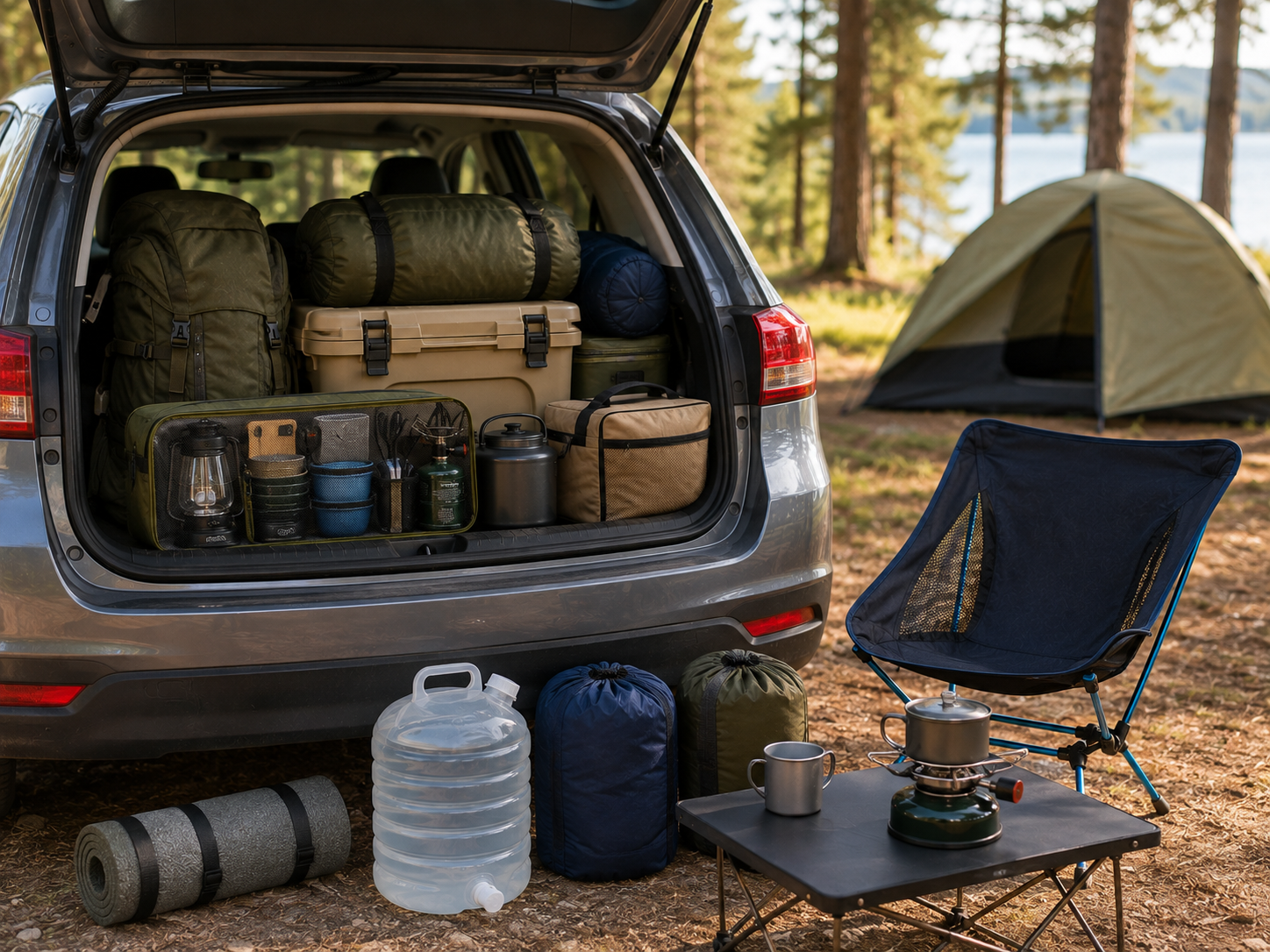
Camping with a small car can feel like a packing puzzle.
A tent goes in first. Then the cooler. Then sleeping bags. Then chairs. Then food. Then cookware. Before long, the trunk is full and you are still standing next to a pile of gear that somehow has to fit.
The solution is not necessarily buying a bigger vehicle.
For many campers, the better approach is choosing camping gear that packs smaller, serves more than one purpose, and fits together efficiently.
If you camp in a compact car, sedan, hatchback, or small SUV, these space-saving camping gear ideas can help you bring what you need without turning every trip into an overloaded mess.
Why Small-Car Camping Requires a Different Approach
When cargo space is limited, every item has to justify the space it takes up.
Large car-camping setups often include oversized chairs, bulky tables, large plastic bins, full-size air mattresses, heavy coolers, and separate gear for every task.
That may work in a truck or large SUV.
In a small car, those choices compete with each other.
The goal is to prioritize gear that is:
- Compact when packed
- Easy to stack
- Lightweight enough to move
- Useful for more than one purpose
- Simple to organize
- Appropriate for the length of your trip
You do not need ultralight backpacking equipment for every item.
You simply need gear that uses space intelligently.
1. Choose a Tent With a Compact Packed Size
Your tent is often one of the largest pieces of camping gear in the car, so packed dimensions matter.
A large family tent with multiple rooms can be comfortable at the campsite but awkward to transport.
For small-car camping, look for a tent that offers enough interior space without using an oversized carry bag.
A simple dome tent often packs more efficiently than a large cabin-style tent.
Consider:
- Number of campers
- Packed length
- Packed diameter
- Pole length
- Whether the tent bag fits horizontally in your trunk
A tent does not have to be tiny.
It simply should not take up half your cargo area by itself.
2. Use Sleeping Pads Instead of a Large Air Mattress
Full-size camping air mattresses can be comfortable, but they can also be bulky.
Some require:
- Mattress
- Electric pump
- Power source
- Extra bedding
A pair of compact sleeping pads may take up significantly less space.
Modern inflatable or self-inflating camping pads can provide good cushioning while rolling or folding down into smaller packages.
For couples, two individual pads can also be easier to fit around other gear than one large mattress.
If you already own a comfortable compact air mattress, there is no need to replace it immediately.
But when space becomes a problem, your sleep system is one of the first areas worth reconsidering.
3. Bring Compressible Sleeping Bags
Sleeping bags can fill a surprising amount of trunk space.
A basic sleeping bag stored loosely in a large sack may be several times larger than necessary.
A compression sack allows you to reduce the volume.
This can be especially useful when carrying several sleeping bags for a family.
Do not leave compressed sleeping bags stored that way permanently at home, though.
Compression is useful for transportation.
For long-term storage, follow the manufacturer’s guidance so insulation can remain lofted properly.
4. Choose Folding Chairs That Pack Narrow
Traditional camping chairs are comfortable, but some models are extremely bulky when folded.
When car space is limited, compare the packed dimensions before buying.
A chair that folds into a narrow carry bag may fit between bins or alongside the tent.
Compact frame chairs can pack even smaller, although they may require more assembly.
The best choice depends on how much comfort you are willing to trade for cargo space.
For most small-car campers, a good middle ground is:
- Standard seat height
- Comfortable back support
- Narrow folded profile
- Simple carry bag
- Moderate weight
Avoid bringing oversized reclining chairs unless you know you have room.
5. Replace a Large Camp Table With a Compact Folding Table
A full-size folding table can be one of the most awkward items to transport.
If your campground already provides picnic tables, you may not need one at all.
If you still want a dedicated cooking or side table, choose a compact folding model.
Look for designs with:
- Folding legs
- Roll-top surfaces
- Carry bags
- Narrow packed profiles
A small table can support a stove, lantern, or food-prep area without taking up much space in the car.
Ask whether you really need a table for four people when your main goal is simply to keep the stove off the ground.
6. Use Stackable Storage Bins
Random bags waste space.
Boxes and bins can create cleaner shapes that are easier to stack.
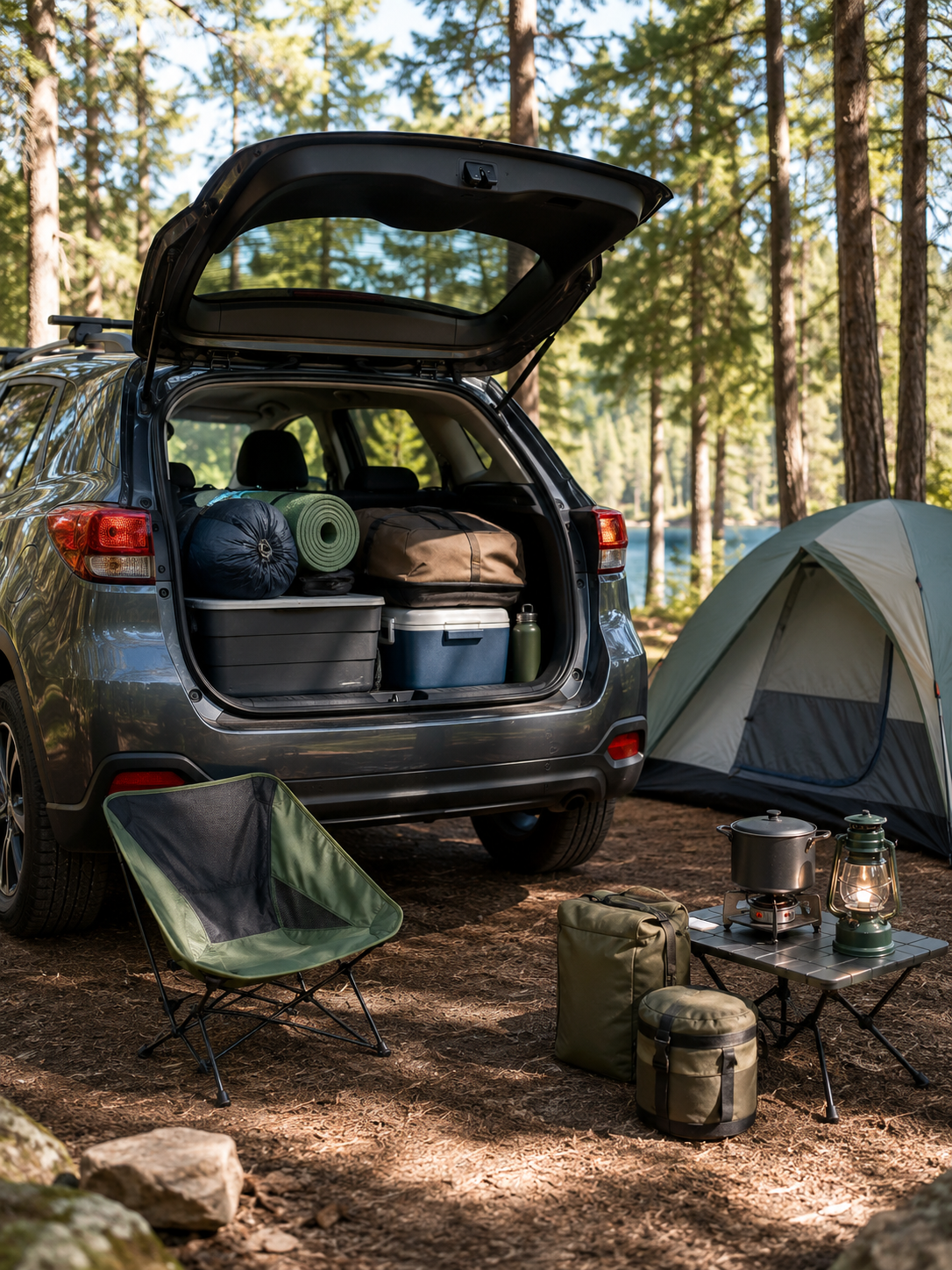
For small-car camping, use bins with straight sides and lids that allow one container to sit securely on top of another.
A simple system might include:
Kitchen bin
Cookware, stove accessories, utensils, and cleaning supplies.
Food bin
Dry foods and snacks.
General gear bin
Lanterns, tools, cords, and miscellaneous items.
Choose bins that fit the actual dimensions of your cargo space rather than buying the largest containers available.
Two medium bins may fit better than one oversized tote.
7. Consider Soft-Sided Storage Bags
Hard bins are useful, but they are not always the most space-efficient option.
Soft gear bags can squeeze into irregular gaps that rigid boxes cannot.
They are useful for:
- Clothing
- Bedding
- Shoes
- Towels
- Lightweight gear
A combination works well.
Use hard bins for items that need protection or structure.
Use soft bags for things that can compress.
This allows you to fill empty spaces around larger equipment.
8. Choose a Cooler That Matches the Trip
One of the biggest packing mistakes is bringing an oversized cooler.
A huge cooler makes sense for a long family trip.
It may be unnecessary for two people camping for one weekend.
Before choosing cooler size, think about:
- Number of people
- Number of nights
- Meals
- Drinks
- Whether stores are nearby
A medium cooler packed efficiently can often handle a short trip.
You can also reduce cooler space by preparing food at home.
Remove unnecessary packaging and transfer food into smaller sealed containers before leaving.
This reduces clutter and helps items fit together better.
9. Use Nesting Camp Cookware
Pots and pans contain empty space.
Nesting cookware takes advantage of that.
Many camping sets are designed so:
- Smaller pots fit inside larger pots
- Cups fit inside cookware
- Handles fold away
- Utensils fit inside the set
Even if you do not buy a dedicated camping set, you can apply the same idea with equipment you already own.
Pack small objects inside larger containers.
A pot can hold:
- Stove lighter
- Dishcloth
- Sponge
- Small utensils
Do not transport empty spaces if something useful can safely fit inside them.
10. Bring One Versatile Stove
For most short camping trips, you do not need multiple cooking systems.
A compact single- or two-burner stove can handle most basic meals.
Avoid packing:
- Large grills
- Multiple burners
- Separate cooking appliances
unless your menu genuinely requires them.
Planning simpler meals can reduce equipment dramatically.
A one-pot dinner requires less cookware, less fuel, fewer utensils, and less cleanup than a complicated meal with several dishes.
Camp kitchen space begins with meal planning.
11. Use Collapsible Water Containers
Large rigid water jugs take up the same amount of space whether they are full or empty.
Collapsible containers solve that problem.
Once empty, many fold down significantly smaller.
They can be useful for:
- Drinking water
- Hand-washing stations
- Cooking water
However, make sure the container is intended for drinking water if you plan to use it for that purpose.
For some trips, several reusable bottles plus one collapsible campsite container may be more practical than multiple rigid jugs.
12. Choose Multi-Purpose Gear
One of the best ways to save space is to make one item do two jobs.
Examples include:
Storage bin + table
A sturdy closed bin can sometimes function as a small side surface at camp.
Blanket + picnic layer
A durable blanket can add warmth at night and provide a clean sitting surface during the day.
Lantern + power bank
Some rechargeable lanterns can provide emergency charging for small devices.
Cook pot + serving bowl
Use the cookware you prepared food in instead of packing separate serving dishes.
Bandana or cloth + cleaning cloth
Simple reusable fabrics can serve several campsite purposes.
Be careful not to choose multi-function gear simply because it has many features.
The best multi-purpose item is one where you genuinely use both functions.
13. Pack Clothing in Compression Cubes
Clothing easily expands to fill every available corner.
Packing cubes help separate items.
Compression-style cubes can reduce volume further.
For a short camping trip, you usually do not need a large amount of clothing.
Pack around the weather forecast and likely activities.
A simple clothing system may include:
- Daily layers
- Warm layer
- Sleepwear
- Rain protection
- Extra socks
- One dry backup outfit
Avoid packing multiple “just in case” outfits unless conditions justify them.
Small cars reward realistic packing.
14. Use the Vertical Space in Your Car
Many people pack only across the floor of the trunk.
That leaves unused space above the gear.
Stackable bins and rectangular bags can help you use height safely.
Place:
- Heavy items low
- Stable bins on the bottom
- Lightweight bedding or clothing above
Avoid creating unstable stacks that could shift while driving.
Gear should be secured so it does not become a hazard during sudden stops.
If your vehicle allows it, cargo organizers or tie-down points can help keep equipment in place.
15. Create a Packing Order Before You Load the Car
Good gear can still waste space if packed randomly.
Before loading, divide everything into three groups.
Items You Need During the Drive
Keep these accessible:
- Water
- Snacks
- Phone charger
- Jackets
- Personal items
Items You Need First at Camp
These should not be buried underneath everything else:
- Tent
- Tent stakes
- Chairs
- Shelter accessories
Items You Need Later
These can go deeper in the cargo area:
- Sleeping bags
- Extra clothes
- Cookware
- Evening supplies
This reduces the need to unload the entire car just to reach one item.
Think in Shapes, Not Just Items
When packing a small car, the shape of an object matters almost as much as its size.
Long narrow items can fit:
- Behind seats
- Along trunk edges
- Between bins
Soft items can fill:
- Gaps
- Corners
- Spaces above hard containers
Flat items can slide:
- Under bins
- Behind seats
- Along the trunk floor
Before buying new camping gear, look at how it packs.
A product that is slightly heavier but shaped efficiently may work better for your vehicle than a lighter product that packs awkwardly.
What Gear Usually Takes Up Too Much Space
If your car is overflowing, start by examining these items.
Oversized Cooler
Often much larger than necessary for a short trip.
Large Air Mattress
Comfortable but bulky.
Full-Size Folding Table
May be redundant when a campsite has a picnic table.
Oversized Chairs
Comfortable but expensive in cargo space.
Large Storage Totes
They encourage overpacking and may not fit together efficiently.
Excessive Cookware
Multiple pots, pans, plates, and kitchen accessories add up quickly.
Too Many “Just in Case” Items
Extra gear usually sounds reasonable at home.
At the campsite, much of it may never leave the car.
Do Not Confuse Compact With Ultralight
Small-car campers do not necessarily need backpacking gear.
Backpacking equipment is designed to reduce both weight and volume because everything must be carried.
Car campers mainly need to manage volume.
That distinction matters.
A compact steel camp chair might be perfectly practical even if it weighs more than an ultralight backpacking chair.
Likewise, a comfortable self-inflating sleeping pad may be better than the smallest possible pad if you sleep better on it.
Focus on:
Packed size first
and then consider weight where it actually matters.
A Simple Small-Car Camping Setup
For two people on a short campground trip, a compact setup might look like this:
Shelter
- One 3- or 4-person dome tent
Sleep
- Two compact sleeping pads
- Two compressible sleeping bags
- Two small pillows
Furniture
- Two compact folding chairs
- Small folding table only if needed
Kitchen
- Medium cooler
- Compact stove
- One nesting cookware set
- Small kitchen bin
Storage
- Two stackable bins
- One soft clothing bag
Lighting
- One lantern
- Two headlamps
Water
- Reusable bottles
- One collapsible campsite water container
That provides plenty of comfort without filling an entire vehicle with equipment.
Pack the Same Way Every Trip
Once you find a packing system that works, repeat it.
Keep related gear stored together at home.
For example:
Kitchen bin stays packed
Instead of rebuilding your kitchen kit every trip, keep commonly used items inside.
Tent bag stays complete
Store stakes, footprint, repair items, and relevant accessories together.
Lighting kit stays together
Lantern, headlamps, cables, and spare batteries can share one small bag.
This reduces packing time and the chance of forgetting something.
It also helps you recognize when you are adding unnecessary equipment.
Take a Photo of Your Loaded Car
This is a surprisingly useful trick.
After successfully packing your car, take a photo before leaving.
Next time you camp, you have a reference showing:
- Where bins fit
- Where the tent went
- How chairs were positioned
- Which items filled the gaps
You do not have to solve the same packing puzzle every trip.
Remove What You Did Not Use
After the trip, make two mental lists.
Used
and
Never touched
Some unused items are still important.
A first-aid kit, rain jacket, or emergency equipment should not be removed simply because you did not use it.
But if you repeatedly bring:
- Extra cookware
- Decorative gear
- Multiple chairs
- Oversized tables
- Clothing you never wear
consider leaving those items home next time.
Your camping setup should become more efficient with experience.
Final Thoughts
Camping with a small car does not mean camping without comfort.
It simply requires more intentional choices.
Focus on camping gear that packs efficiently, stacks well, compresses when possible, and earns the space it takes up.
Start with the biggest items first:
Tent, sleep system, chairs, cooler, and storage bins.
Those usually determine whether your vehicle feels organized or overloaded.
Then look for opportunities to reduce wasted space through nesting cookware, collapsible containers, soft storage bags, and multi-purpose gear.
You do not need to replace everything you own.
Improve your setup gradually as you discover which pieces create the biggest packing problems.
The smartest small-car camping setup is not the one with the least gear.
It is the one where everything you bring has a clear purpose—and everything fits without a struggle.